
Website bandwidth refers to the amount of data a website can transfer to users over a specific period, usually measured in seconds, minutes, or months. It determines how much information—such as images, videos, text, and scripts—can move between a web server and a visitor’s browser at any given time. Higher bandwidth allows more data to flow quickly, which helps websites load faster and handle more visitors simultaneously.
Bandwidth plays a critical role in website performance. When a site has limited bandwidth, pages may load slowly or fail to load during high traffic periods. This can lead to a poor user experience, increased bounce rates, and lower search engine rankings. On the other hand, sufficient bandwidth ensures smooth loading, better responsiveness, and improved accessibility across devices.
Website owners often receive bandwidth limits as part of their hosting plans. If a site exceeds this limit, the hosting provider may slow down the site, charge extra fees, or temporarily take it offline. For this reason, it is important to monitor bandwidth usage and choose a hosting plan that matches the website’s traffic and content needs.
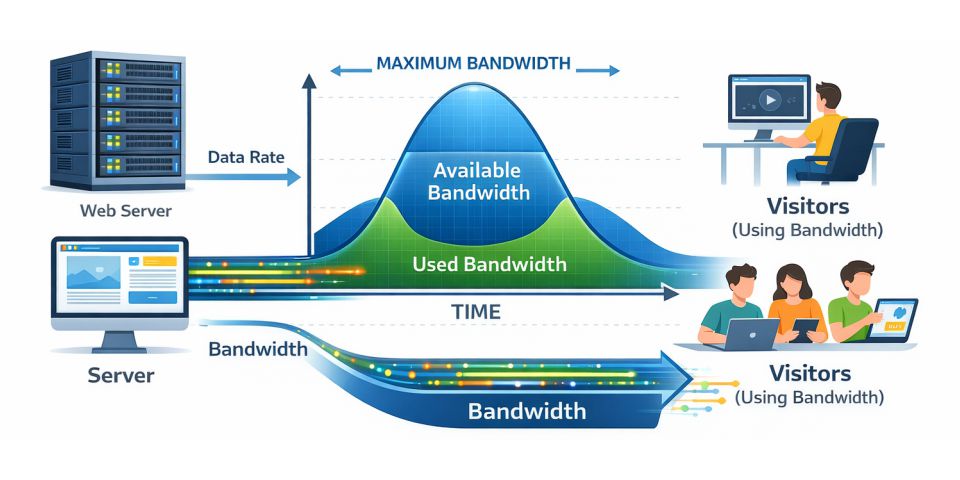
Several factors influence bandwidth usage. These include the number of visitors, the size of web pages, and the type of content displayed. For example, high-resolution images and videos consume more bandwidth than simple text-based pages.
To optimise website bandwidth, site owners can compress images, enable caching, and use content delivery networks (CDNs). These strategies reduce data transfer and improve loading speed. In summary, website bandwidth directly affects how efficiently a site delivers content, making it essential for performance, user satisfaction, and SEO success.